7 Year Bitch
Kathleen
Gasperini
The first time I met 7 Year Bitch, Selene Vigil, the tiny lead singer with
a powerhouse vocal box, was on the deck of the Big Bear Ski Lodge. She was
struggling to put on klunky snowboard boots. They had just finished their
10:30 a.m. set for BoardAID and fuck the other bands--the Bitches were going
snowboarding. Bassist Elizabeth Davis was stuffing her messy blonde locks
into a hat and waved me over. "We have a shoot in a hour with MTV and then
some magazine, but let's get a burrito later."
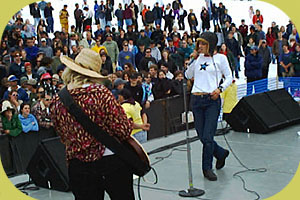
7 Year Bitch proved again that they are one of
the best live girl bands in the world. And the crowd agreed. |
In line for burritos, we chatted for three minutes before she was towed away
for another photo shoot for another magazine. I was bummed. But I think so
was she because I got an e-mail two days later. "Nice to meet you! Let's
for sure hook up in Salt Lake City..."
I'd known about 7 Year Bitch for about five years, but honestly, it was mostly
for their notorious and almost mythical sidebar press rather than their music.
When they hit the scene in 1990, they were the beautiful, feminist, women
rockers-of-riff and bass-driven rock/punk--precursors of the Riot Grrrl movement
and way more moving than the grunge that was making their hometown Seattle
a suddenly cool place to live. They were infuriated women with attitude and
way too raw energy. No sycophants here. And then in 1992, guitarist Stefanie
Sargent died from an OD of heroin. A year later came the brutal rape and
murder of a their friend and fellow label-mate, Mia Zapata from the Gits,
which in memory of her spirit prompted them to co-found Home Alive--a project
to empower women through self-defense, which resulted in a CD with compilations
from 7 Year Bitch and a variety of other Seattle-based luminaries. In what
seemed like a quest for justice, their first album "Sick 'Em" was for Stefanie,
their second, "Viva Zapata!" was for Mia. And then there was their release
a year ago, "Gato Negro," produced by Billy Anderson (of the Melvins and
Nirvana fame) on Atlantic. This one, I think, was for themselves.
We did finally get to talk with them before their show in Boise, Idaho. But
unlike their songs and press, they don't seem angry. If anything, it is an
intellectual discourse about how to listen "with different ears," about the
femaleness of rock, wacky fans, "Lagoon" nail polish, e-mail, beige food,
and the meaning of nepotism. Elizabeth Davis, the bass player, main songwriter,
and most vocal of the group, has such an extensive vocabulary, I found myself
fascinated with her witty expressions and poetic feminism, writing down words
"to look up" for later.
But it was Selene, who's usually super quiet, that first sat down with us
and spoke. Like the elf woman before us, her words are short and simple and
profound at the same time. From beneath heavy black bangs she'd say things
like, "My job is to sing the things we feel;' "I was once a gymnast... "
"I never wondered if I could do this--I just do it," and then she trails
off, just slightly, which we excuse for possible mental preparation for her
upcoming performance.
Selene had never played music growing up because all her time was consumed
with gymnastics. When she turned 19, she tore a knee ligament and her gymnastic
career abruptly ended. "But I discovered a new life--I moved to Seattle,"
she says. Like Elizabeth, she went to a lot of shows and just sort of started
writing lyrics purely by happenstance. But before my next question, about
the source of her power, she has quietly disappeared in the smoky haze of
the bar room.
Unfortunately Valerie Agnew, co-founder of Home Alive, was busy hanging out
with her drum teacher who happened to be in town, which was cool, but we
didn't get much of chance to talk. But we did rap with guitarist and newest
member Roisin Dunne. When it comes to making music, the Bitches have a formula,
sort of. "Most the time [we'll] come up with a riff and then we'll all build
around that," says Roisin. She talks about newly found cohesiveness and weird
fans. During the show, I think of how she said her parents feel--so proud
that their daughter, like themselves--at least is finally on stage. I want
be Roisin. I want to be a rock star, too.
After a few glasses of a nice, full-bodied red wine and after the lingering
effects of the adrenaline rush of a live performance begin to seep in, that
is when Elizabeth writes and creates her best guitar riffs. Late, on nights
like these. But it wasn't always easy. As a matter of fact, when Elizabeth
and Selene first started, they were real beginners and had never played on
a stage. With only three songs under their belt, they still had the courage
to do it.
How was it to be a couple of women on stage with little experience and an
audience staring at you for the anomaly that, five years ago, you really
were? "Well," explains Elizabeth, "it's not as likely that guys would get
up there and do that, but it's almost like we were girls and as an anomaly,
it was almost as if we were allowed to fuck up because we had nothing to
lose. That gives you room. Take a look at big corporations--they almostalways
have women as mediators to explain their mess-ups with the environment, say.
It's like, [in a baby voice] 'Aw, look, the girly spilled the oil in the
water...' " We laugh. But it's true.
They all are stoked about their new CD. Lyrically, musically, spiritually,
it came together. We agree. "Gato Negro," Elizabeth sums up, "is more about
the music than the ghosts of our past. It's about what we really are." Finally.
Back To BBC
Index
SOL | Snowboarding Online |
