|
Calendar of Events Have you subscribed to SOL Groove? |
Legends Of The Fall: Josh Brownlee Tells His
Story |
Snow Summit To Host ESPN's Winter X Games NZ Resorts Won't Open Thanks To Volcano |
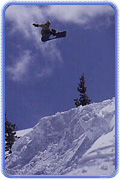
| On April 21, Josh Brownlee, a Vermont native living in Tahoe for the
winter, was out riding Donner Summit with his girlfriend Wendy Powell and
photographer Angie Silvy. Toward the end of the day Josh wanted to try a
cliff band he'd been eyeing all day. That's when Josh made a pretty big mistake.
It wasn't stupid, it wasn't reckless, it was just a miscalculation --the
kind we all make from time to time. It's just Josh's was on a 60 foot cliff.
The short story is that Josh came up short--way short. After being evacuated and rushed to Reno, Josh spent the following 21 days in the hospital. His accident sent a buzz through the snowboarding community and has been called one of the worst accidents a professional snowboarder has ever survived. Photographer Chris Carnel called 911 after watching Josh rag doll through the rocks. "I thought he was dead," Carnel said. "I really can't believe he lived. I've never seen anything like it." Snowboarders risking their lives for the camera is nothing new, however, some people are beginning to wonder if Kodak courage is pushing riders a little too far. After a month spent in a Reno hospital bed Josh probably wonders a little. But it's all about decisions. Here is Josh's story in his own words: Was it worth it? You decide. "At the Ride house in Tahoe the head of my bed is near the window so I can peak out and see when it is cloudy and decide whether I should get up or not without even moving. That morning there were scattered clouds. "Wendy and I had talked about doing something like riding Squaw. She called me from her house and said our friend Angie Silvy had called and wanted to shoot. Of course I thought, sure why not. The more you go out and shoot, the more exposure you get in the mags and stuff. I was really into charging because it was my first year doing this kind of thing [snowboarding for a career]. "When Wendy called me back an hour later it had definitely cleared up. She suggested that we go to ASI, a spot near Donner Ski Ranch. It's on a sketchy windy road called Old 40. The area is all hiking, and I had worked there a lot this season. "I had ridden by the same line I took that day and had looked at it, but never rode it. We picked up Angie and the sky kept getting even more sparse with clouds, opening to blue sky. When we got there [to ASI] jib-bonkers were pulling up everywhere, so we decided to high step it and cover tracks before everyone else did. It's a popular spot for kids working on getting shots. "We started the day with pow turns in this one gully. We eventually headed up spectators left where there is this nice rock about twenty-feet high. Two feet of fresh windblown snow lay under the rocks. Angie was super stoked on the angle and so we started riding that rock. We were there probably an hour and a half until we bum holed it out. "Finally when it was chopped, we began looking at this other spot. Every time I hiked back up I would see this set to the left. It ranged from about 60 to 10 feet from skiers left to right. I decided to charge it. Angie got ready and Wendy was waiting down below. We were pretty much getting ready to go down and have a beer after this shot. "When I looked at the cliff I thought if I went toward the steep stuff and took a really hard heel turn, I would pop out and land near Angie. I tossed some snowballs so she would know where I was going off. This is where it gets blurry. I know I should have checked it out better. "In '93 I broke my patella in two pieces, so I have definitely been carrying a look-before-you-go attitude. But when you have conditions like we had that day, it's really easy to charge to hard. I think I just wanted to really get it. I pointed my snowboard and I probably had about ten to fifteen feet to get speed and was on about a 45 degree incline. I definitely went too far skiers' left. What I remember was popping off in a really nice ollie. It was just a really bad line to take. "So, I am in the air and I don't see anything except brown and red and green, then rocks. Wendy said I put together a pretty long line of cuss words when I realized how off I was, but I don't remember that. I don't remember the impact either. "The next thing I remembered was a real sharp pain in my butt. I could feel a crack in the rock, which I think held me from falling an additional twenty feet down the mountain. I was in complete confusion. I remember being draped over Wendy and leaning on her chest. I kept saying, you've got to get me off this rock. The rest is a vague confusion, then sedation of my body, and the sound of the ambulance. I knew that it was going to Reno. "My next real strong memory would be them (the hospital technicians) trying to find the femoral artery so they could pump dye into my legs to see if the arteries were clogged. They were and my leg went into spasm. I have a real vivid memory of watching this yellow and clear gas mask dropping onto my face, and it hit me then that I was super drugged up in Reno in the intensive care unit. "The next week was a blur of saline solution and morphine drips. I took pain killers every fifteen minutes and there was no feeling. I was so out of it. Both legs were totally wrapped up and one knee was in a range of motion machine because the knee had been dislocated. The constant movement of this machine kept my knee from seizing up. "I had a lot of visitors the first week. My pop arrived the next eve from Vermont, my brother from San Francisco, Wendy, Angie, Pat Abrams, Andy Coghlan, Jim Hale, the whole team. Andy Coghlan really cheered me up. I could pretty much say I owe my career to him from when he sponsored me skating in the Boarding House days. There were lots of other people that I am probably forgetting because I was so out of it. It was good to have visitors. "I spent five days in intensive care. On the last day I was allowed to change to a solid food diet. When the nurse told me, a couple of people were visiting, and we all kind of looked up at the bag to see how much IV food I had left. There was about a third left and the technician said that we might as well wait until it was gone because each bag cost 2,000 dollars. 2,000 dollars! "The next fifteen days after being moved out of the ICU was all a hell that I can't even explain. Dealing with operation after operation, being addicted to a serious drug like morphine. The drugs gave me hot flashes and nightmares. The nightmares were so vivid and fast and scary. I woke up sweating a lot. "I went the first eight days without moving my bowels. Total misery on a bed pan. The painkillers don't let you be normal. Then I experienced being completely helpless, which is really hard when you are 22 years old and doing what I had been doing for a living. Being in one position on your back and ass for twenty days is miserable. Here's a good statistic: it takes only one week of complete immobility to lose 50 percent of your muscle strength. It'll be a while before I am charging at full speed again. "I am now realizing how nice it is to be able to just do anything. Walking in the bathroom or going to the kitchen to get a drink, simple things we take for granted. It's hard just going from having the best day snowboarding, to being helpless having to ask for everything. "During the twenty days in the hospital I had major reconstruction on my left knee and my heel bone was rebuilt. At first with my heel the surgeons were boggled by how they were going to get it all back together. The x-rays showed about fifty pieces. They were thinking they might have to fuse the tibia and fibula, which would take away all of the rotation in my ankle. Also the forefoot and hindfoot were dislocated so they put pins in there to heal that part. "Somehow they figured it out though and that operation went really well. The surgeon was surprised when he saw how well it all worked. After 21 days they transferred me to a rehabilitation hospital down the street. "I have been here [at the rehabilitation hospital] six days now and I have five more. After the third day here I could transfer myself from the toilet to the chair. That was a good feeling. Now I have this thing called a reacher. It's like a robot hand, so I can grab stuff around the room. I still have a lot of trouble at night because I have to sleep in one position "The hardest thing about this is that all of the pain is really extreme. I do an hour and a half of physical therapy and an hour and a half of occupational therapy every day. Occupational therapy is doing things like putting on your own clothes and learning how to do everyday things while you're in a wheel chair. "In five days I will be able to leave here and move to the Bay Area where I will live with my brother and Wendy. I'm looking at probably another month in a wheel chair and then six eight weeks on crutches favoring my left side. Then it will be a little while before I am able to rehabilitate my right. I am looking at about a year and a half of no charging. "I think about the accident every day. I realize that if I hadn't had landed on my feet on the rocks but had landed on my back or head I would be a paraplegic or dead. I often need to remind myself that no matter what, it could be worse. "One thing I can't emphasize enough is that you need to look before you leap. Everybody just can't do it enough. The more extreme it gets, the more you've got to check it. "It's important that kids know how fucking brutal it is to not be able to do anything for yourself. Imagine what it is like to not even be able to go to the bathroom without an enema. If you drop something on the floor it's gone. Not being able to be active at 22 sucks. But I am alive, so I am lucky. |
 |
          |